

Mount Rinjani may be the first reason many travelers visit northern and eastern Lombok, but the villages around the mountain offer more than trekking trails and crater views.
Coffee is part of that landscape.
Across the foothills and highland areas surrounding Rinjani, local communities grow arabica and robusta coffee, process beans on a small scale, and serve coffee in villages where mountain life, farming, and tourism naturally meet.
A Lombok coffee tour can therefore be much more than stopping at a café.
Depending on where you go, the experience may include walking through farmland, seeing coffee cherries on the plant, learning how beans are dried and roasted, meeting local farmers, watching traditional processing, and drinking coffee close to where it was produced.
This makes coffee particularly easy to combine with a Mount Rinjani trip.
Before trekking, it can be a relaxed introduction to rural Lombok. After trekking, it provides a slower way to experience the communities around the mountain without immediately rushing to another demanding activity.
This guide covers the most interesting areas to consider around Rinjani, including Senaru and Bayan, Sembalun, Tetebatu, and the East Lombok highlands, plus practical ideas for adding local coffee to your Lombok itinerary.
Table of Contents
- Why Coffee Belongs in a Mount Rinjani Itinerary
- Best Areas for Local Coffee Near Rinjani
- Senaru and Bayan
- Sembalun
- Tetebatu
- Sapit and the East Lombok Highlands
- What Happens on a Lombok Coffee Tour?
- From Coffee Cherry to Cup
- Do You Need to Be a Coffee Expert?
- Coffee Tour Before or After Rinjani?
- Best Options for Different Travelers
- Suggested Coffee and Rinjani Itineraries
- Responsible Coffee Tourism
- Frequently Asked Questions
Why Add a Lombok Coffee Experience to a Rinjani Trip?
Rinjani trekking and coffee tourism offer two very different ways to experience the same part of Lombok.
On the mountain, the rhythm is physical.
You walk for hours, manage elevation changes, follow the trail, camp overnight, and organize your day around the trekking itinerary.
A coffee experience slows everything down.
Instead of thinking about the next trail section, you can spend time in a village, walk through farmland, talk with local people, see how agricultural products are processed, and sit down with a cup of locally grown coffee.
That contrast is one of the strongest reasons to combine the two.
Rinjani shows the dramatic natural landscape.
Coffee introduces you to some of the communities living around that landscape.
In 2026, the Rinjani Geopark management highlighted local coffee as a potential tourism experience for Mount Rinjani visitors, noting that both arabica and robusta plantations can be found around the mountain.
For travelers who want to understand the connection between trekking and local coffee before planning a visit, the Adi Trekker guide to Lombok coffee and Rinjani is a useful starting point.
Where Is the Best Place for a Lombok Coffee Tour Near Rinjani?
There is no single best location.
The most convenient destination depends on which side of Lombok you are already visiting.
| Area | Best For | Coffee Experience | Easy to Combine With |
|---|---|---|---|
| Senaru & Bayan | Rinjani trekkers | Local farms, village coffee, farmer connection | Senaru trekking, waterfalls |
| Sembalun | Highland scenery | Mountain-grown coffee, cafés, local producers | Summit routes |
| Tetebatu | Deeper cultural experience | Traditional coffee processing, agriculture | Rice fields, waterfalls, village tours |
| East Lombok Highlands | Rural exploration | Small-scale farm and community experiences | East Lombok road trips |
If your trip already includes Rinjani, choosing a coffee destination based on your existing route is usually better than crossing Lombok only for a cup of coffee.
Senaru and Bayan: Local Coffee Near the Rinjani Trekking Gateway
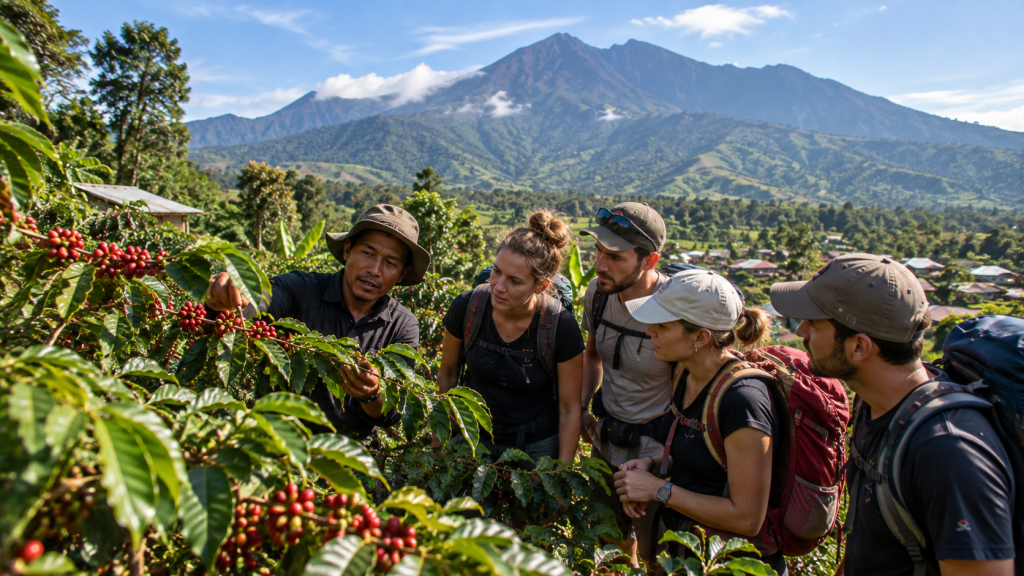
Senaru is one of the most natural places to combine coffee with a Rinjani journey.
The village sits on the northern side of Mount Rinjani and is closely connected with trekking, agriculture, waterfalls, and village tourism.
Coffee cultivation is also part of the area.
Coffee produced in Senaru has included both arabica and robusta varieties, and local farmers have historically connected with international travelers through the Rinjani trekking community.
This makes coffee here feel less like a separate attraction and more like part of everyday life around a trekking village.
What Can You Do Around Senaru?
Depending on what is available during your visit, a local experience may involve:
- Visiting a small coffee plantation
- Seeing coffee plants and cherries
- Meeting local growers
- Learning basic processing methods
- Watching roasting or grinding
- Tasting local coffee
- Combining coffee with village walking
Bayan and other communities around North Lombok can also provide a broader cultural context because traditional villages and agricultural areas are located relatively close to the Rinjani gateway.
Who Should Choose Senaru?
Senaru is particularly convenient if you:
- Are trekking Rinjani from the north
- Stay in Senaru before your trek
- Want a low-effort activity before hiking
- Prefer not to change hotels repeatedly
- Want to combine coffee with waterfalls or village walks
- Are interested in photography and local life
If you want to explore the area beyond coffee, the Senaru Panorama Walk and waterfall experience combines village landscapes, rice fields, Sendang Gile, and Tiu Kelep.
Sembalun: Coffee in the Rinjani Highlands
Sembalun offers a different atmosphere.
The area is widely recognized by hikers as an important gateway for summit-oriented Mount Rinjani routes, but farming is also a major part of the surrounding highland landscape.
Coffee is increasingly part of that story.
Recent reporting from Sembalun describes efforts to maintain coffee as part of the region’s cultural, agricultural, and tourism identity. Local coffee is grown around the volcanic landscape at the foot of Rinjani, alongside other agricultural activities.
Why Drink Coffee in Sembalun?
The appeal here is partly the setting.
A coffee stop may come with views of:
- Rinjani’s surrounding slopes
- Highland farms
- Valleys
- Agricultural fields
- Village landscapes
For travelers already passing through Sembalun for trekking, this makes coffee an easy addition.
You do not necessarily need a full-day coffee tour.
Sometimes the best experience is simply spending an hour at a local producer or highland coffee spot after arriving in the village.
Sembalun Works Well For:
- Summit trekkers
- Road-trip travelers
- Photographers
- Couples
- Travelers interested in mountain agriculture
- People who want coffee without adding another full tour day
The combination of coffee and tourism is also receiving more attention in the area as part of efforts to strengthen the cultural and economic identity of communities around Rinjani.
Tetebatu: One of the Best Places for a Deeper Coffee Experience
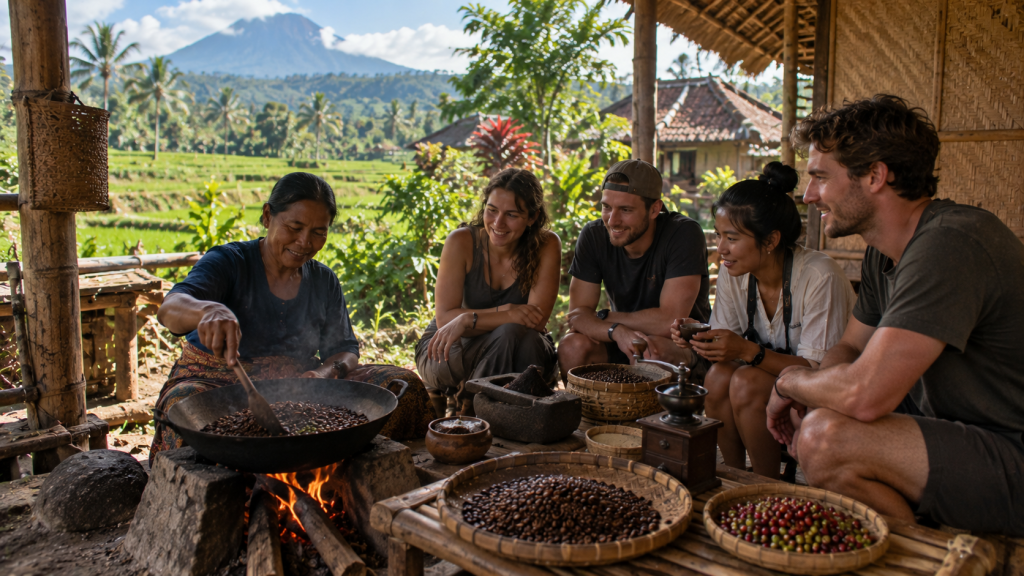
If coffee itself is an important part of your trip, Tetebatu deserves serious consideration.
Tetebatu lies on the southern side of the Rinjani landscape and offers a much greener, agricultural travel experience.
Rice fields, waterfalls, forest areas, spices, village paths, and traditional farming activities make the destination especially suitable for slow travel.
Indonesia’s official tourism portal specifically highlights traditional coffee processing as one of the eco-farm experiences visitors can try in Tetebatu. Activities can involve learning how local coffee is produced while also discovering other village products and spices.
Why Tetebatu Feels Different
In Tetebatu, coffee can become part of a broader village experience rather than a standalone tasting session.
A day might include:
Rice fields → village walk → local farm → coffee processing → lunch → waterfall → forest
This makes Tetebatu particularly attractive if you want to spend an entire day away from major tourist centers.
Traditional processing can also be part of the experience, including small-scale roasting and grinding at local homes.
Adi Trekker’s Tetebatu activities similarly include rural landscapes, waterfalls, village life, agricultural products, and coffee breaks with local residents.
For a broader look at the destination, see the Tetebatu village and nature experience from Adi Trekker.
Who Will Enjoy Tetebatu Most?
Choose Tetebatu if you:
- Want a deeper village experience
- Like slow travel
- Enjoy agriculture and local culture
- Want more than a quick café stop
- Enjoy photography
- Have an additional day before or after Rinjani
- Want to combine coffee with rice fields and waterfalls
Sapit and the East Lombok Highlands
Travelers exploring East Lombok may also encounter coffee-growing communities outside Tetebatu and Sembalun.
Sapit is one of the highland areas that can appear in locally organized agricultural and coffee experiences.
Experiences here may focus more strongly on rural life than polished tourism infrastructure.
That can include seeing coffee farming, drying, roasting, and brewing at community level.
However, these experiences are often more locally arranged and can change according to season and availability.
Rather than assuming there is a fixed daily coffee tour, ask locally before making a special journey to the area.
Sapit is most practical for travelers who are already exploring East Lombok and want to go deeper into rural landscapes.
What Usually Happens on a Lombok Coffee Tour?
There is no standardized Lombok coffee-tour format.
A simple experience may last less than an hour.
A more immersive visit can take several hours and include different stages of coffee production.
1. Walk Through the Plantation
You may first see where the coffee is grown.
This is where the coffee story becomes easier to understand because you can see the plant rather than only the roasted bean.
2. Learn About Coffee Cherries
Coffee starts as a fruit.
Depending on the season, you may see green or ripe cherries growing on branches.
3. See Processing and Drying
After harvesting, coffee has to be processed before becoming the roasted beans most travelers recognize.
Small producers may explain how the fruit is handled and how beans are dried.
4. Watch Roasting
Some village experiences demonstrate roasting using relatively simple equipment or traditional techniques.
The roasting stage changes the aroma dramatically.
5. Grinding and Brewing
After roasting, the coffee is ground and prepared.
Methods can vary from one household or producer to another.
6. Drink the Final Cup
The tasting becomes much more meaningful once you have seen where the coffee comes from.
Instead of simply asking whether it tastes good, you understand more of the work behind it.
From Coffee Cherry to Cup: Why the Process Matters
Most travelers encounter coffee only at its final stage.
You order a drink and receive a finished cup.
A farm visit reverses that perspective.
You begin with the plant.
Then you see fruit, beans, drying, roasting, grinding, and brewing.
That transformation is what makes agricultural tourism interesting even for travelers who are not coffee enthusiasts.
It connects a familiar daily product with:
- Land
- Climate
- Farming
- Labor
- Village knowledge
- Local economy
Around Rinjani, volcanic soils and varied elevations help support different coffee-growing environments, which is one reason local coffee is increasingly being discussed as part of the wider Rinjani tourism experience.
Do You Need to Be a Coffee Lover?
No.
You do not need to understand espresso extraction, roast profiles, or specialty-coffee terminology.
A coffee tour can also appeal to travelers interested in:
- Agriculture
- Village culture
- Photography
- Food
- Sustainability
- Local economies
- Slow travel
For many visitors, the best part may not even be the coffee.
It may be sitting with a local family, seeing the farming landscape, or learning how a product they drink every morning is created.
Is It Better Before or After Mount Rinjani Trekking?
Both can work.
Coffee Tour Before Rinjani
A coffee experience before trekking works well if you want:
- A relaxed first day in Lombok
- Time to recover from your flight
- Minimal physical effort
- A cultural introduction before hiking
Senaru is particularly practical because many Rinjani trekkers already spend a night there before starting.
Coffee Tour After Rinjani
After trekking, coffee tourism can feel even better.
You have already spent several physically demanding days on the mountain.
Instead of immediately starting another adventure activity, you can slow down.
Tetebatu or a village experience can work well if you have additional recovery days.
For travelers still choosing their trekking duration, the Mount Rinjani 2D1N, 3D2N, and 4D3N package comparison can help determine how much time remains for other Lombok destinations.
Lombok Coffee Tour for Couples
Coffee and village experiences work particularly well for couples who prefer experiential travel.
A day around a plantation or village is much slower than a summit itinerary.
That creates space to:
- Walk together
- Take photographs
- Talk with local residents
- Stop without rushing
- Enjoy food and coffee
- Experience a quieter side of Lombok
For honeymooners who do not want every day centered around beaches or resorts, combining Rinjani with rural Lombok can create a more varied itinerary.
Why Photographers and Content Creators May Prefer Coffee Villages
Rinjani provides large-scale landscapes.
Coffee tourism gives you smaller details.
Possible subjects include:
- Coffee cherries
- Farmers’ hands
- Drying beans
- Roasting
- Smoke and steam
- Traditional houses
- Agricultural landscapes
- Portraits
- Village activity
That creates a stronger visual contrast in a travel story.
Instead of returning with only mountain photographs, you document the communities surrounding the mountain as well.
Always ask permission before taking close portraits or photographing people inside their homes.
A Good Choice for Backpackers
Backpackers can enjoy local coffee without dramatically increasing travel costs by planning geographically.
If you are already staying in Senaru, explore there.
If your trek ends or begins in Sembalun, try coffee in Sembalun.
If you are heading south or east after trekking, spend time in Tetebatu.
Avoid repeatedly crossing the island only to collect destinations.
Good itinerary planning is often about reducing unnecessary travel time.
Suggested Rinjani and Coffee Itineraries
3-Day Short Lombok Experience
Day 1: Arrive → Senaru → local coffee and village time
Day 2: Short Rinjani or crater experience
Day 3: Waterfalls → next Lombok destination
Best if your time is limited.
5-Day Trekking and Coffee Trip
Day 1: Arrive → Senaru → coffee and preparation
Day 2–4: Mount Rinjani trekking
Day 5: Recovery and local village experience
This gives you a better balance between trekking and culture.
6–7 Day Slow Adventure
Day 1: Arrive in Lombok
Day 2–4: Rinjani trekking
Day 5: Rest
Day 6: Tetebatu village, farms, and coffee
Day 7: Waterfall, beach, or onward travel
This format is better for travelers who do not want every day to feel rushed.
Combine Coffee with Other Lombok Experiences
Coffee does not have to become the only activity after Rinjani.
Senaru can be combined with waterfalls.
Tetebatu combines naturally with rice fields, forests, waterfalls, and local agriculture.
Travelers heading farther around Lombok can also add cultural or coastal destinations.
Adi Trekker offers several Lombok day-tour options alongside Rinjani trekking, including Senaru waterfall and cultural stops. See the Lombok daily tour options from Adi Trekker for ideas.
The goal should not be to fit everything into one trip.
Choose experiences that naturally connect.
Responsible Coffee Tourism in Lombok
Coffee tourism works best when it supports local communities rather than treating farms as photo sets.
A few simple habits help:
- Ask before photographing people
- Respect private farming areas
- Follow local guides
- Do not pick coffee cherries without permission
- Buy directly from producers when appropriate
- Avoid leaving waste
- Allow enough time for conversations
- Do not expect every farm to operate like a commercial tourist attraction
Buying a small bag of locally produced coffee can also be a meaningful souvenir because it connects your trip directly with the agricultural community you visited.
Frequently Asked Questions About Lombok Coffee Tours
1. Where Can I Try Local Coffee Near Mount Rinjani?
Senaru, Bayan, Sembalun, Tetebatu, and other East Lombok highland areas are worth considering. Senaru and Sembalun are easiest to combine directly with Rinjani trekking, while Tetebatu offers a deeper village and agricultural experience.
2. Is Tetebatu Good for a Coffee Tour?
Yes. Indonesia’s official tourism information specifically highlights traditional coffee processing as part of Tetebatu’s eco-farm activities.
3. Is Coffee Grown in Senaru?
Yes. Senaru has a documented history of both arabica and robusta coffee production, including local farmers selling coffee to visitors connected with the Rinjani trekking community.
4. Is Coffee Grown Around Sembalun?
Yes. Coffee farming and coffee culture are part of the agricultural landscape around Sembalun and are increasingly being connected with local tourism and cultural identity.
5. Should I Visit a Coffee Farm Before or After Rinjani Trekking?
Either works. Before trekking, it provides a low-intensity introduction to Lombok. After trekking, it works well as a slower recovery-day activity.
Plan Your Lombok Coffee Tour Around Mount Rinjani
A Lombok coffee tour adds something to a Rinjani journey that mountain views alone cannot provide.
It takes you away from the summit and back into the villages.
In Senaru and Bayan, coffee connects naturally with North Lombok’s trekking communities.
In Sembalun, highland farms and mountain scenery create a different coffee atmosphere.
In Tetebatu, coffee becomes part of a wider rural experience involving agriculture, rice fields, waterfalls, and village life.
And in other parts of East Lombok, smaller community experiences can reveal an even quieter side of the island.
You do not need to visit every location.
Choose the one that fits naturally into your travel route.
If Mount Rinjani is the main reason for your trip, start by deciding your trekking duration and route.
You can use the complete Mount Rinjani planning guide from Adi Trekker to understand trails, weather, permits, and preparation.
Then add a coffee experience where it makes geographical sense.
For travelers interested specifically in Tetebatu, explore the Tetebatu nature and village experience.
If you are still arranging your Rinjani trekking dates and want to combine the mountain with other Lombok experiences, contact Adi Trekker to discuss the itinerary.
WhatsApp: +62 819-9102-8066
A journey around Rinjani does not have to end when you leave the trail.
Sometimes another side of the mountain begins with a quiet village, a local farmer, and a cup of Lombok coffee.