

Photos of Mount Rinjani often show the most memorable parts of the journey: sunrise from the summit, Segara Anak Lake, dramatic crater views, camping above the clouds, and long mountain ridges.
But before reaching those moments, there is something every traveler should understand:
What actually happens each day on a Rinjani trekking itinerary?
A Mount Rinjani trek is not simply about walking to a destination and returning.
Each day has a different rhythm. There is registration and preparation, several hours of trekking, scheduled rest and meal stops, campsite preparation, early-morning summit attempts on certain itineraries, and eventually the descent back to the finishing point.
The exact experience depends on the route and package you choose.
A 2D1N summit trek is much more compressed than a 3D2N or 4D3N itinerary, while the Senaru Crater Rim 2D1N offers a completely different experience from a summit-focused journey.
Adi Trekker organizes Mount Rinjani trekking programs through routes including Sembalun, Senaru, and Torean, with different durations and trekking goals.
This guide explains what usually happens before the trek, how each day progresses, and how common Rinjani itineraries differ so you can choose a trip based on your fitness, available time, and travel goals.
Table of Contents
- Rinjani Trekking Itinerary at a Glance
- What Happens Before the Trek Starts?
- What Usually Happens on Day 1?
- What Happens During Rest and Meal Stops?
- What Is the First Night on Rinjani Like?
- What Happens on Summit Day?
- Rinjani Summit 2D1N Itinerary
- Rinjani Summit 3D2N Itinerary
- Rinjani Summit 4D3N Itinerary
- Senaru Crater Rim 2D1N
- What About a One-Day Rinjani Hike?
- How Sembalun, Senaru, and Torean Change the Itinerary
- Guide, Porter, Food, and Camping Logistics
- Weather and Itinerary Changes
- How to Choose the Right Itinerary
- Frequently Asked Questions
Rinjani Trekking Itinerary at a Glance
Before looking at each day in detail, here is a simple comparison of the most common trekking formats.
| Itinerary | Typical Main Experience | Pace | General Consideration |
|---|---|---|---|
| One Day Hike | Shorter Rinjani trekking experience | Compact | Suitable when time is limited |
| Senaru Crater Rim 2D1N | Forest, crater rim, camping, sunrise | Moderate | No main summit required |
| Summit 2D1N | Sembalun Crater Rim + 3,726 m summit | Very compact | Physically demanding |
| Summit 3D2N | Summit + Segara Anak + additional trail sections | Balanced but challenging | More complete mountain experience |
| Summit 4D3N | Summit, lake, hot springs, longer mountain experience | Less rushed | More days of continuous trekking |
The table is only a general overview.
Exact routes can differ between packages, especially when a trek finishes through Senaru, Sembalun, or Torean.
For a broader package comparison, see the 2D1N, 3D2N, and 4D3N Mount Rinjani trekking packages.
What Happens Before the Trek Starts?
A Rinjani trekking itinerary often begins before you actually step onto the trail.
Depending on the package, travelers may arrive in Senaru the previous day, meet the trekking team, organize their personal gear, receive itinerary information, and prepare for an early departure.
Before trekking, you should make sure:
- Your physical condition is good
- You have slept adequately
- Your personal trekking gear is ready
- You understand what the operator provides
- You understand what you need to carry yourself
- You know the selected route and finishing point
- You understand the guide’s instructions
Registration is also part of the process before entering the official trekking route.
Travelers should review the current mandatory trekking rules from Gunung Rinjani National Park before planning the trip.
Current rules published in June 2026 include requirements related to minimum group size, guide or experienced-hiker accompaniment, previous mountain-hiking experience, and environmental responsibility.
That means the itinerary should begin with proper preparation rather than simply arriving at the mountain and starting to walk.
What Usually Happens on Day 1?
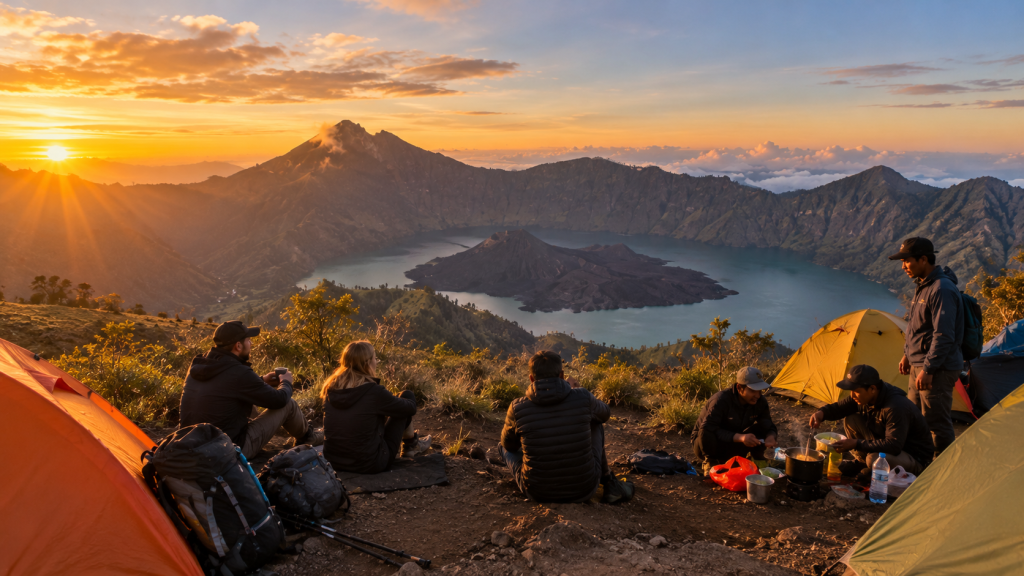
For summit itineraries starting through Sembalun, Day 1 generally introduces you to the trekking rhythm.
The journey typically begins after breakfast and transportation to Sembalun.
After registration, the group begins trekking through the Sembalun landscape toward the crater rim.
On Adi Trekker’s Mount Rinjani 2D1N summit itinerary via Sembalun, the first day progresses through several trekking posts before reaching Sembalun Crater Rim at approximately 2,639 meters.
The published itinerary estimates around 6–7 hours of walking on Day 1, although actual trekking time depends on the participants and trail conditions.
Day 1 Is About Finding Your Pace
Many travelers begin with too much energy.
The mountain still feels new, everyone is excited, and it can be tempting to walk faster than necessary.
That is usually not the best strategy.
Maintaining a steady pace can help preserve energy for later sections, particularly if your itinerary includes a summit attempt the following morning.
A good first day is not about reaching camp first.
It is about reaching camp with enough energy to continue the itinerary.
What Happens During Rest and Meal Stops?
Rinjani trekking includes planned breaks.
You are not expected to walk continuously from morning until evening without stopping.
Rest periods give participants time to:
- Drink water
- Eat
- Recover energy
- Adjust clothing
- Rest their legs
- Communicate with the guide
- Prepare mentally for the next section
On multi-day trips, food plays an important role in maintaining energy.
Adi Trekker’s current package information lists full-board meals, drinking water, trekking guides, porters, and camping equipment among the services included in its trekking packages.
However, participants should still confirm the exact inclusions of their selected package before departure.
Do not wait until you feel completely exhausted before eating or drinking.
Managing energy gradually is much easier than trying to recover after becoming severely fatigued.
What Is the First Night on Mount Rinjani Like?
For most multi-day itineraries, the first night is spent at a campsite.
On summit trips starting from Sembalun, the first campsite is commonly around Sembalun Crater Rim.
After arriving, the porter team typically organizes the campsite and prepares the evening meal.
For first-time multi-day trekkers, camping can be one of the most memorable parts of the experience.
But the first night is not only about taking photos.
If your itinerary includes the summit, you may need to wake up in the middle of the night.
That makes rest extremely important.
Prepare warm clothing, organize your headlamp and essential equipment before sleeping, and avoid staying awake unnecessarily if you have an early summit departure.
What Happens on Summit Day?
Summit day is usually the most physically demanding part of a summit itinerary.
Mount Rinjani reaches approximately 3,726 meters above sea level.
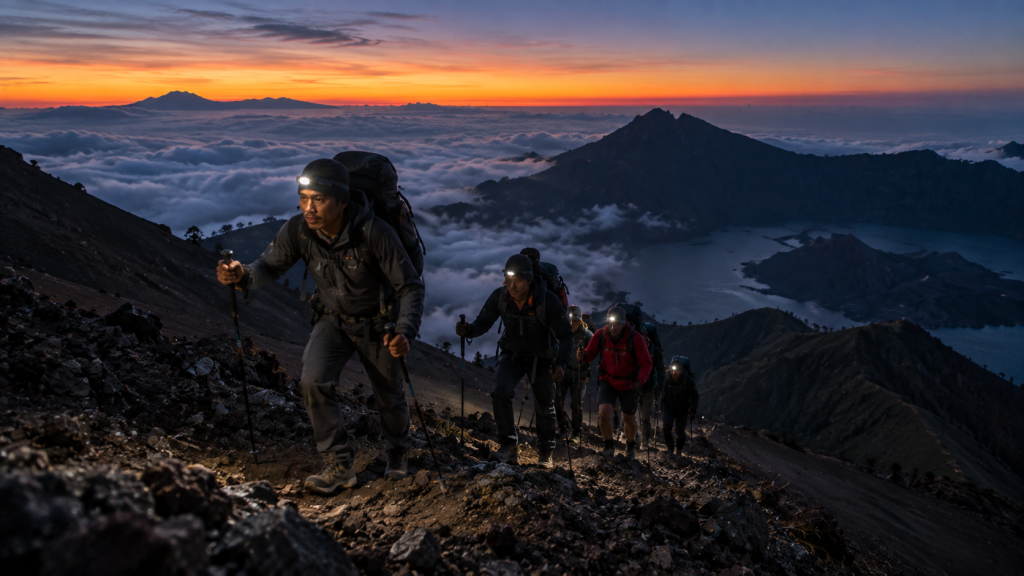
On the 2D1N summit itinerary from Sembalun, trekkers typically wake around 2:00 AM, have a light breakfast, and begin the summit climb at approximately 3:00 AM.
The objective is normally to reach the summit around sunrise.
The published itinerary describes the final section as increasingly steep and difficult.
After reaching the summit, the journey is far from over.
You still need to descend.
What happens after that depends entirely on your package.
A 2D1N participant normally returns toward Sembalun on the same day, while longer itineraries may continue toward Segara Anak Lake, the hot springs, Senaru Crater Rim, or another route.
This is why summit day should never be viewed as simply:
“Climb up, take photos, finished.”
There can still be several hours of trekking after the summit.
Rinjani Summit 2 Days 1 Night: What Happens Each Day?
The 2D1N summit trek is one of the most compact ways to attempt Mount Rinjani’s main summit.
It should not be confused with an easy or beginner itinerary simply because it lasts fewer days.
Day 1: Sembalun to Sembalun Crater Rim
The journey typically includes:
Sembalun Village → Trekking Posts → Sembalun Crater Rim
Participants trek through the open Sembalun landscape before climbing toward the crater rim.
The day ends with camping around 2,639 meters.
Day 2: Crater Rim → Summit → Sembalun
The second day begins very early.
The general sequence is:
Sembalun Crater Rim → Rinjani Summit 3,726 m → Crater Rim → Sembalun Village
After the summit attempt and sunrise, trekkers descend back to camp, eat, recover briefly, and then continue down toward Sembalun.
This creates a demanding second day because the summit is only one section of the day’s total activity.
Adi Trekker describes its 2-day Rinjani summit trek as a physically challenging itinerary better suited to travelers who are prepared for a compressed schedule.
Rinjani Summit 3 Days 2 Nights: What Happens Each Day?
A common 3D2N summit itinerary provides more time to explore Rinjani beyond simply reaching the summit.
One version offered by Adi Trekker begins in Sembalun and finishes through Senaru.
Day 1: Sembalun → Sembalun Crater Rim
Day 1 follows the classic Sembalun ascent.
The group reaches the crater rim and camps overnight.
Day 2: Summit → Segara Anak Lake → Senaru Crater Rim
This can be the biggest day of the journey.
On the 3D2N Mount Rinjani summit itinerary via Sembalun, trekkers make the early summit attempt before descending toward Segara Anak Lake.
Depending on the itinerary, the day may also include time near the hot springs before climbing again toward Senaru Crater Rim.
This means Day 2 can involve:
Summit climb + descent + lake + another ascent
It is one reason Rinjani should not be underestimated.
Day 3: Senaru Crater Rim → Senaru Village
After sunrise and breakfast, the final day generally focuses on descending.
The route leads through the Senaru side of the mountain and eventually returns toward the village.
Although it is the last day, fatigue from the previous two days may already be noticeable.
Maintain your pace instead of rushing simply because the finish is getting closer.
Important: Not Every 3D2N Is the Same
Adi Trekker also offers route variations.
Some programs may finish through Torean or return to Sembalun instead.
Always read the exact itinerary rather than assuming every 3D2N package follows the same route.
Rinjani Summit 4 Days 3 Nights: What Happens Each Day?
A 4D3N trip provides additional time on the mountain.
It can feel less compressed than shorter summit programs, but that does not mean it requires less preparation.
You still need enough endurance for four consecutive trekking days.
One common Sembalun–Senaru version follows this pattern:
Day 1: Sembalun → Sembalun Crater Rim
The trek begins through Sembalun and reaches the first campsite at the crater rim.
Day 2: Summit → Segara Anak Lake
After an early summit attempt, the group descends toward the lake.
The longer format provides more time around Segara Anak compared with some shorter programs.
Day 3: Segara Anak → Senaru Crater Rim
The journey continues from the lake toward the Senaru side.
Another night is spent on the mountain.
Day 4: Senaru Crater Rim → Senaru Village
The final day involves descending through the Senaru route and returning to the village.
Adi Trekker also has a 4D3N Rinjani summit itinerary via Sembalun designed around a longer mountain experience.
What About the Torean Route?
Another 4D3N option may use Torean as the finishing route.
In a Sembalun–Torean itinerary, the journey after Segara Anak continues through valleys, rivers, forests, and waterfall scenery before finishing in Torean Village.
This creates a noticeably different final part of the trek.
That is why route choice matters just as much as duration.
Senaru Crater Rim 2 Days 1 Night
Not every traveler needs to choose the main summit.
The Senaru Crater Rim 2D1N trekking itinerary provides another way to experience Rinjani.
Day 1: Senaru Village → Senaru Crater Rim
The route begins through the Senaru side, including tropical forest sections before climbing toward the crater rim.
Adi Trekker’s published itinerary estimates approximately 7–8 hours for the first-day trek.
Camp is set up around Senaru Crater Rim at approximately 2,641 meters.
Day 2: Sunrise → Descend to Senaru
After spending the night at the crater rim, participants can enjoy the morning scenery before beginning the descent.
The journey then returns through the Senaru trail.
This itinerary can appeal to travelers whose priority is experiencing:
- Mountain trekking
- Forest trails
- Crater views
- Camping
- Sunrise
without making the main 3,726-meter summit the central goal.
What About a One-Day Rinjani Hike?
Adi Trekker also offers shorter one-day trekking programs.
A one-day hike can appeal to travelers with limited time or those who are not planning a multi-day camping itinerary.
However:
One day does not automatically mean easy.
Difficulty still depends on:
- The selected route
- Elevation gain
- Walking duration
- Weather
- Trail conditions
- Your fitness
If you are comparing shorter and multi-day options, review the complete Rinjani trekking itinerary options rather than choosing based only on the number of days.
How Do Sembalun, Senaru, and Torean Change the Itinerary?
Route choice has a major impact on what you experience each day.
Sembalun
Sembalun is commonly used for summit-focused itineraries.
The route begins with more open landscapes and leads toward Sembalun Crater Rim, which becomes the staging point for the main summit attempt.
Senaru
Senaru provides a different trekking environment, including tropical forest.
It can be used for crater-rim itineraries and as a finishing route on longer treks.
Torean
Torean is often used as an alternative exit on itineraries that pass through Segara Anak Lake.
Its scenery includes valleys, rivers, cliffs, waterfalls, and forest sections.
If you are unsure which route fits your goals, read the Sembalun vs Senaru Mount Rinjani route guide before choosing your package.
The route should be chosen as part of the itinerary, not as a separate decision.
Does an Open Trip Follow the Same Itinerary as a Private Trip?
Usually, the main route and destination are determined by the package.
However, the experience of following that itinerary can be different.
On a sharing trip, the guide manages several participants.
Rest timing and trekking rhythm therefore need to consider the group.
A private trek focuses only on you or your own travel group, which may provide a more personal atmosphere.
If you are a solo traveler or backpacker considering a group departure, see the Mount Rinjani sharing trekking package.
Trip format does not change the mountain itself.
Weather, trail conditions, safety decisions, and national park regulations still apply to both private and sharing treks.
How Are Meals and Drinking Water Managed?
Food is part of the trekking logistics.
Multi-day hiking requires regular energy intake, so meals should not be treated as an optional extra.
Adi Trekker’s current package information lists:
- Breakfast
- Lunch
- Dinner
- Hot drinks
- Snacks
- Fruits
- Drinking water
among its standard trekking logistics for applicable packages.
Your guide and porter team coordinate meal stops around the trekking schedule.
Still, travelers should verify package inclusions before booking because services can differ between tour categories.
What Does the Guide Do Throughout the Itinerary?
A trekking guide does more than show you where to walk.
Throughout the itinerary, the guide helps with:
- Pace management
- Route direction
- Rest timing
- Communication
- Assessing the journey in current conditions
- Coordinating the trekking group
- Making decisions when plans need adjustment
If you feel unusually tired, dizzy, unwell, or uncomfortable, tell the guide.
Do not hide physical problems because you are worried about slowing down the group.
The itinerary is important, but your condition matters more than staying exactly on schedule.
What Do Porters Carry?
Porters support the logistics required for trekking.
Adi Trekker states that its standard porter team carries group trekking equipment and logistics such as:
- Tents
- Sleeping bags
- Mattresses
- Cooking equipment
- Food
- Water
- Other group supplies
Personal belongings are generally a different matter.
If you want someone to carry your personal backpack, ask whether an additional personal porter needs to be arranged.
Knowing this before departure avoids confusion on Day 1.
What Should You Prepare for Each Morning?
Preparation does not stop after the first day.
Each morning, check:
- Your physical condition
- Hydration
- Clothing layers
- Footwear
- Headlamp if departing early
- Personal medication
- Water
- Small snacks
- Weather protection
If something does not feel right physically, communicate early.
Multi-day trekking means small problems can become bigger if ignored for several hours.
What Happens If the Weather Changes?
A Rinjani itinerary is a plan, not a guarantee.
Mountain conditions can change.
Weather can affect:
- Visibility
- Trail conditions
- Departure time
- Summit attempts
- Walking speed
- Overall itinerary decisions
Before departure, travelers can check the official BMKG weather forecast for North Lombok.
However, a regional forecast cannot perfectly predict conditions at high elevation.
Actual conditions on the mountain and instructions from guides or national park authorities should take priority.
This also explains why an itinerary shown online should not be interpreted as a promise that every stage will happen at exactly the stated time.
Why Is a Longer Itinerary Not Automatically Harder?
It seems logical to assume:
4 days must be harder than 2 days.
But itinerary difficulty is more complicated.
A longer trip requires you to remain active for more days.
However, a shorter itinerary can compress a large amount of climbing and descending into a much smaller period.
For example, the 2D1N summit trek requires participants to reach the crater rim on Day 1 and complete both the summit attempt and major descent on Day 2.
A longer itinerary distributes the Rinjani experience across additional days.
So when comparing packages, evaluate:
Daily workload, not only total duration.
How Should First-Time Rinjani Trekkers Choose an Itinerary?
Start with your actual experience and fitness.
Ask:
- What mountains have I previously hiked?
- How long can I walk comfortably?
- Am I comfortable with steep terrain?
- Can I recover overnight and walk again?
- Is reaching the summit essential to me?
- How much time do I have in Lombok?
- Do I prefer a compact challenge or slower experience?
Current TN Gunung Rinjani rules also require previous mountain-hiking experience, so travelers who have never climbed another mountain should review the latest official Rinjani hiking requirements before booking.
Do not choose an itinerary simply because it produces the most impressive photos.
Choose one you are realistically prepared to complete.
What Is Suitable for Backpackers?
Backpackers often consider:
- Budget
- Available travel days
- Sharing-trip availability
- Transportation
- Recovery time
- Other Lombok destinations
If social travel suits you, a Mount Rinjani sharing trekking tour can be worth comparing with a private trek.
Also leave some flexibility in your broader Lombok schedule.
Completing a multi-day trek and immediately planning another physically demanding activity the same day is not always ideal.
What Is Suitable for Solo Travelers?
Solo travelers can consider either a sharing or private format.
A sharing trip can make the journey more social and allow you to join other trekkers.
A private trip provides a more personal environment.
But itinerary difficulty remains the same consideration.
Being solo does not mean you should automatically choose the shortest program.
Choose according to fitness, trekking experience, available time, and preferred pace.
Responsible Trekking Is Part of the Itinerary
Every day on Mount Rinjani takes place inside a protected natural area.
That means the experience should include responsible environmental behavior.
Official TNGR rules emphasize reducing waste and carrying reusable food and drink containers.
Trekkers should:
- Avoid leaving rubbish
- Follow guide instructions
- Use designated routes
- Respect wildlife
- Avoid damaging vegetation
- Follow national park regulations
A successful Rinjani itinerary is not only about reaching the final destination.
It should also leave the mountain in good condition for the people who come after you.
What Happens on the Last Day?
The final day normally focuses on completing the descent and reaching the finishing village.
Depending on your itinerary, that may be:
- Senaru
- Sembalun
- Torean
The last day can feel psychologically easier because you know the trek is almost finished.
Physically, however, accumulated fatigue may be significant.
Downhill walking can also place considerable stress on the legs.
Maintain control and avoid rushing.
After completing the official trail, transportation arrangements depend on the selected trekking package and your next destination in Lombok.
Frequently Asked Questions About Rinjani Trekking Itineraries
1. What Is the Most Popular Mount Rinjani Trekking Itinerary?
The 3D2N summit format is a common choice because it can combine the main summit with additional Rinjani experiences such as Segara Anak Lake and other trail sections. However, the best itinerary depends on your fitness, previous trekking experience, available time, and preferred route.
2. Is a 2D1N Rinjani Trek Easier Than a 3D2N Trek?
Not necessarily. A 2D1N summit itinerary is shorter but much more compressed. Participants need to reach the crater rim on Day 1 and complete the summit attempt plus the descent on Day 2. Fewer days do not automatically mean less physical demand.
3. What Time Does the Rinjani Summit Trek Start?
On summit itineraries, the summit attempt commonly begins in the early morning. Adi Trekker’s 2D1N Sembalun itinerary lists waking around 2:00 AM and starting the summit trek around 3:00 AM to aim for sunrise.
4. Can I Trek Rinjani Without Going to the Main Summit?
Yes. Options such as the Senaru Crater Rim 2D1N trek allow travelers to experience mountain trekking, camping, forest scenery, and crater views without making the 3,726-meter summit the primary goal.
5. Can a Rinjani Itinerary Change During the Trek?
Yes. Mountain weather, trail conditions, participant condition, safety considerations, and instructions from authorities can require changes. Treat the published itinerary as the planned journey rather than an unconditional guarantee.
So, Which Rinjani Trekking Itinerary Is Right for You?
There is no single itinerary that is automatically best for every traveler.
A 2D1N summit trek suits a very different travel style from a 3D2N or 4D3N program.
Likewise, a Senaru Crater Rim trek offers a different goal from reaching the main summit.
Before choosing, consider:
Fitness + Previous Experience + Daily Trekking Load + Available Time + Route + Travel Goals
Then decide whether you prefer a private or sharing format.
The goal is not simply to spend the fewest or most days on Mount Rinjani.
The goal is to choose an itinerary whose daily activities match the experience you actually want.
Compare Mount Rinjani trekking packages from Adi Trekker to see the available 2D1N, 3D2N, 4D3N, summit, and crater-rim options.
Still unsure which itinerary suits your fitness, travel dates, and previous trekking experience?
Contact Adi Trekker directly on WhatsApp to discuss the route and duration that best match your trip.
You can also visit the official Adi Trekker website to explore Mount Rinjani trekking routes, package details, and additional Lombok travel information.
Understanding the itinerary before you arrive means fewer surprises on the trail and a much clearer idea of what each day on Mount Rinjani will actually involve.