
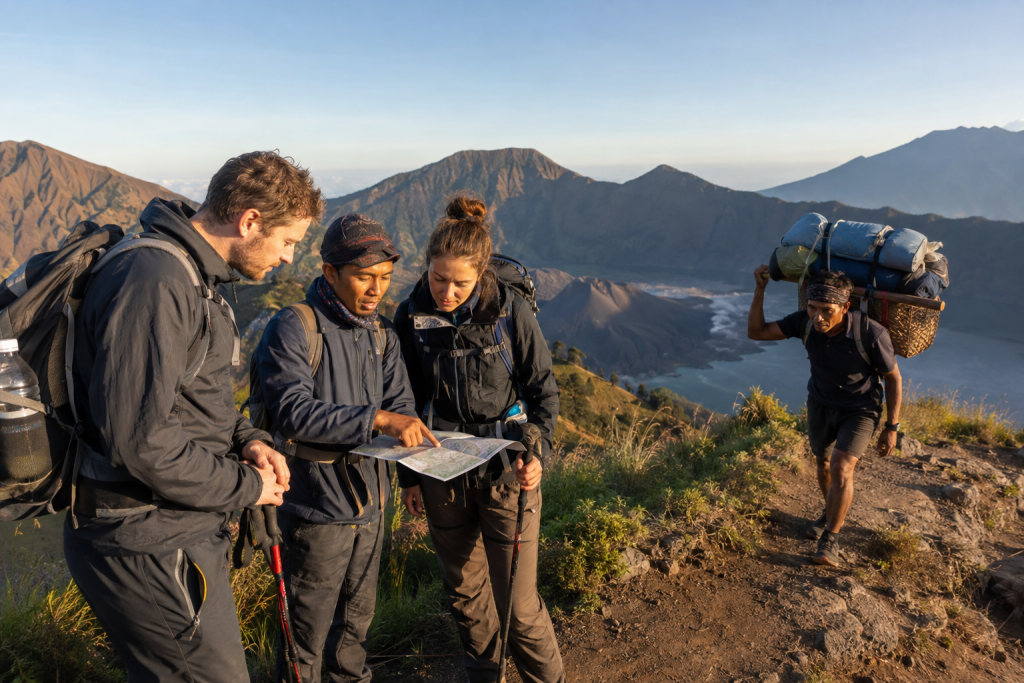
Mount Rinjani rises more than 3,700 meters above Lombok, making it the second highest volcano in Indonesia. Every year, thousands of hikers attempt its summit, yet almost none of them do it alone. Behind every successful climb is a team of local guides and porters who carry, cook, and navigate so that trekkers can simply focus on putting one foot in front of the other.
If you are a solo traveler thinking about tackling Rinjani, understanding the roles of your Rinjani guide and porter team is one of the most useful things you can do before you book. It shapes how much you pay, how smooth your trek feels, and how much you enjoy the experience overall.
This guide breaks down exactly what guides and porters do, how their costs are usually structured, how many porters a typical group needs, and how to tip them the right way.
Why Solo Travelers Need a Support Team on Rinjani
Rinjani is not a casual afternoon walk. The trails are steep, the weather changes fast, and the terrain around the crater rim can be unforgiving even for experienced hikers.
For a solo traveler, a guide and porter team is not a luxury. It is the difference between a trek that feels manageable and one that becomes genuinely risky without local knowledge of the mountain.
A guide keeps you on the correct trail, reads changing weather conditions, and knows how to respond if altitude sickness or fatigue sets in. A porter carries the heavy equipment, so your energy goes toward the climb instead of your backpack.
Traveling solo also means there is no one else to share decisions with when things get tough. Having an experienced local team beside you fills that gap and turns a solitary trip into one where you still feel supported every step of the way.
What Does a Rinjani Guide Actually Do?
A guide is essentially your mountain leader from start to finish. Their main job is navigation, safety, and pacing, especially during the early morning summit push when trails are dark and narrow.
Guides working around Senaru and Sembalun typically speak English and have spent years learning the mountain’s moods. They know which sections turn slippery after rain and when it is wiser to slow down rather than push forward.
Beyond safety, a guide also acts as a cultural bridge. Many are happy to share stories about Sasak traditions, local beliefs tied to the mountain, and life in the villages surrounding Rinjani, which adds real depth to the trip beyond the physical challenge.
What Does a Porter Actually Do?
Porters are the backbone of trek logistics. They carry tents, cooking equipment, food supplies, and communal gear, often balancing impressive loads on traditional bamboo carriers across uneven trails.
Their day usually starts earlier than everyone else’s. Porters move ahead to set up camp and prepare meals, so that by the time hikers arrive at each stop, a hot meal and a ready tent are already waiting.
This role demands serious physical stamina, and it is one of the reasons full board meals and camping equipment are included in most Rinjani packages. Without porters, multi day treks on this mountain would be far harder to complete comfortably.
How Guide and Porter Costs Are Usually Structured
Guide and porter fees on Rinjani are generally built into the total price of a trekking package rather than charged as a completely separate line item. This includes park entrance fees, meals, safe drinking water, and full camping equipment alongside the guiding and portering service itself.
Costs tend to shift depending on a few factors. Private trips usually cost more per person than sharing trips, simply because the guide and porter team is dedicated entirely to one group instead of being split among several travelers.
The route and trip length also matter. A One Day Hike naturally needs a smaller support team than a 3 day 2 night or 4 day 3 night summit package, which involves more gear, more meals, and more distance to cover.
As a general guideline, expect private trip pricing to sit noticeably higher than sharing options, while multi day summit packages cost more overall than a Senaru Crater Rim trip or a One Day Hike. Exact figures vary by season and group size, so it is best to request a tailored quote for accurate numbers.
How Many Porters Do You Actually Need?
Porter numbers scale with group size and trip length, not with personal preference. A solo traveler on a private trip will typically still be supported by more than one porter, since food, water, tents, and cooking gear add up quickly even for one person.
As group size grows, the number of porters increases proportionally to keep the pace comfortable for everyone. Longer treks, such as the 4 days 3 nights summit route, also require more porters than a 2 days 1 night trip because there is simply more to carry over more days.
A reliable operator will calculate the right porter to trekker ratio during the planning stage, so you never need to guess this number yourself. It is worth asking directly when you book, especially for a private Rinjani trip, so expectations are clear from day one.
Tipping Etiquette: Showing Respect the Right Way
Tipping guides and porters is customary on Rinjani and is genuinely appreciated, though it is never mandatory. Most trekkers choose to tip at the end of the trip, once the trek is fully completed.
A simple approach many hikers follow is to prepare a modest amount per day, per team member, and then hand it over directly at the end rather than throughout the trek. Guides typically receive a slightly higher amount than porters, given their added responsibility and experience.
It also helps to have small denomination local currency ready in advance, since finding change on the mountain is not always possible. If you are trekking with a small group, pooling tips together and giving them as one gift often feels more organized and personal than separate individual tips.
Ultimately, tipping is a way of recognizing hard physical work done in tough conditions, and most trekkers find it a small gesture that carries real meaning for the local team supporting them.
Choosing the Right Rinjani Guide and Porter Team
Not every operator treats their guide and porter team the same way. Some cut corners on equipment or staffing ratios, which can affect both safety and comfort on the mountain.
Adi Trekker has organized Rinjani treks for more than 15 years, working with local guides and porters from Senaru and Sembalun who know these trails intimately. Trekking gear is renewed every year, and the operation follows a strong eco tourism and zero waste commitment inside the national park, which matters on a mountain that sees heavy foot traffic each season.
For solo travelers who want a dedicated team rather than a shared arrangement, private trip options are available across the Sembalun, Senaru, and Torean routes, with return transport, park fees, meals, and camping equipment all included from the start.
Final Thoughts on Rinjani Guide and Porter Support
A Rinjani guide and porter team is what turns a demanding volcano climb into an achievable, well supported adventure, especially for solo travelers heading up the mountain on their own. Guides keep you safe and on track, porters keep you fed and equipped, and both roles deserve fair recognition through respectful tipping at the end of the journey.
If you are planning a solo Rinjani trek and want a private trip with an experienced local team behind you, Adi Trekker is ready to help you plan every detail. Reach out through aditrekker.com to check availability and get a tailored quote for your private Rinjani trekking experience.